In the project ‘Agropole Innovates’ four German-Dutch teams are developing solutions for current challenges:
- Evaluation of organic materials from insect production as potential fertilisers and soil improvers.
- Reduced use of crop protection agents through early detection of diseases and pests in nurseries.
- Development of learning algorithms and use of AI to respond more quickly to diseases and pests.
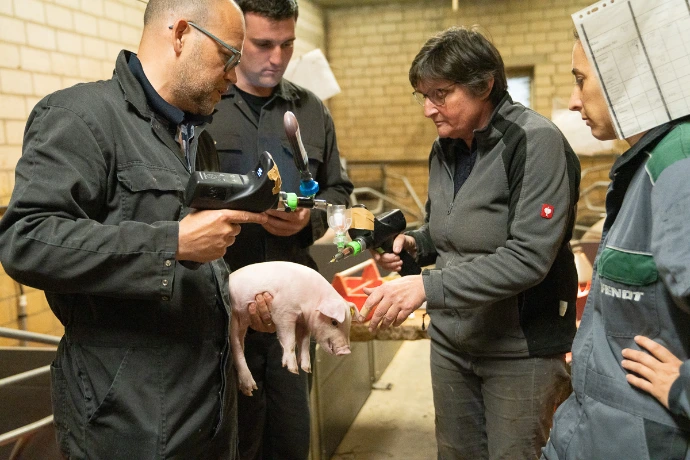
- Improvement of animal welfare, efficient use of resources and food safety for greater transparency in pig farming.
The innovation platform is the connecting element between these projects.
In the project, new knowledge is gained and technologies for saving water, energy, pesticides and other resources are further developed. This not only protects the environment and the climate, but also helps companies prepare for the future. Moreover, new business and revenue models can emerge. An important aspect is also the digitisation and automation of processes, which simplifies operational procedures, reduces the workload and increases the attractiveness of the business world in the funeral industry. At the same time, this provides opportunities to increase the transparency of product characteristics and production processes for consumers.
The Agropole Innovates project is being implemented within the framework of the Interreg VI programme Germany-Netherlands and is co-financed with 2.025 million euros by the European Union, the Dutch Ministry of Economic Affairs (EZK), MKWIKE NRW and MB Niedersachsen, as well as the province of Limburg.
Collaborating on disease prediction
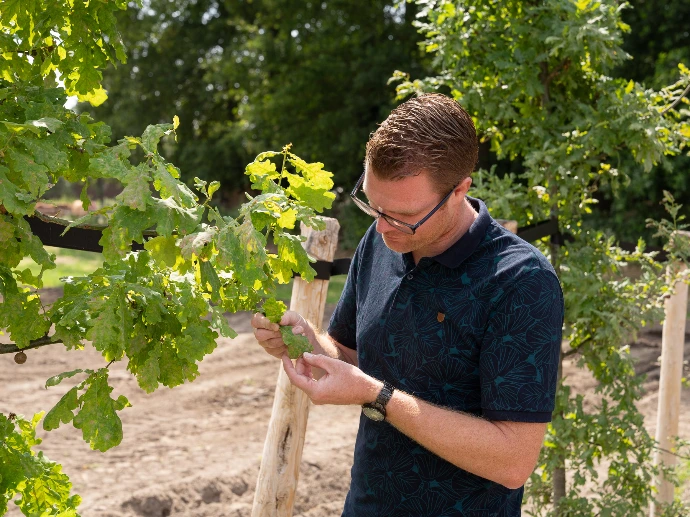
In this project, Yookr is collaborating with Compass Agro, ISIS IC and Baume & Bonheur on predictive models and software and visualisation and weather data connections for the cultivation of fruit trees. For this, we select sensor technology and build forecasting models that can teach us something about disease pressure and moisture deficit.
“Existing models for predicting plant diseases are usually based on multiple temperature and humidity data from the soil, air or the surface of the leaves. This data is recorded via sensors and transmitted to a software program via radio technology,” says John van Helden, owner of Yookr. “New in this project is that we will create self-learning algorithms for the first time to correlate both historical data and active live data and predictive values from different sensor types. This makes it possible to obtain predictions of diseases.”
Thanks to these developments, the stock files in nurseries can become healthier and stronger, and the trees and shrubs can contribute more to CO2 storage in the climate transition. “For nurseries, we need to achieve savings in the areas of irrigation, plant strength, use of nutritional supplements and pesticides. And for humans, animals and nature, a higher storage of CO2 is what we are aiming for.”
The Agropole Innovates project started on 1 September 2022 and ends on 31 August 2026. It is being implemented as part of the Interreg VI Germany-Netherlands programme and is co-financed with 2.025 million euros by the European Union, the Dutch Ministry of Economic Affairs (EZK), the MWIKE NRW and the MB Niedersachsen and the Province of Limburg. The project has a total budget of approximately 3.7 million euros. About 1.7 million of this is financed by the ten project partners themselves.
More information can be found at: https://deutschland-nederland.eu/ and at https://www.agrobusiness-niederrhein.de/projekte/agropole-innovates.
Made possible by:
Use this section to enhance your company's credibility.